Excessive Daytime Sleepiness impacts one out of ten Australians and has serious impacts on their physical and mental well-being. Studies have shown the problem to increase with age, impacting younger and older people and giving rise to a plethora of health problems.Women and men with an increased BMI are especially predisposed to the problem.While the problem starts with extreme fatigue during the daytime, it eventually progresses into an inability to focus, increased errors, academic and job issues, leading to layoffs and livelihood hazards. Impaired ability to make decisions because of EDS further causes mortality risks by increasing the risk of accidents and falls.
Psychostimulants like Amphetamine do come in handy in reducing the symptoms, but with the added risk of addiction and dependence. In such conditions, Artvigil saves the day by emerging as a safe, effective and well-tolerated wakefulness agent.
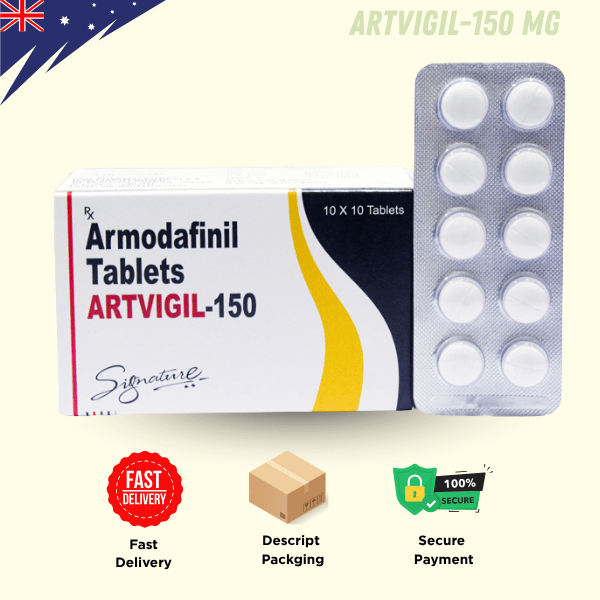
Artvigil 150 is a novel new-generation psychostimulant designed to treat abnormal drowsiness in individuals in a safe manner.We can safely consider it a eugeroic, containing Armodafinil as its active ingredient- a characteristic that results in a longer half-life and higher plasma concentrations than other eugeroics and enables you to stay alert longer. Because it is an enantiomer (R-isomer) of Modafinil, it has the same properties as Modafinil but with a safer nature.
Artvigil is medically approved to treat daytime drowsiness in narcoleptics and OSA patients and enable shiftworkers to stay focused and functionally capable during their shift period.Research has shown Artvigil to bind to the CNS neurotransmitters regulating the sleep-wake cycle to mitigate sleep disorders.
Artvigil 150 binds to the cell membrane dopamine transporters (DAT) in the ventral tegmental area (VTA) of the brainstem and inhibits their reuptake to increase dopamine concentrations. The VTA is a crucial mid-brain region rich in dopamine-producing neurons that is involved in reward, motivation and arousal. The VTA-dopamine neurons further promote wakefulness and, through unique firing patterns during REM and NREM stages, influence sleep-wake cycles.
Consequently, it is the abnormal activity in the VTA coupled with the loss of orexin neurons that impacts the dopamine molecules, which disrupts the sleep-wake cycles. Not only does it contribute to the characteristic symptoms of narcolepsy, like daytime sleepiness, but it also targets emotional processing and attention.By increasing the of dopamine concentnsratio in the VTA, Artvigil enhances wakefulness-promoting and motivation-related functions.
Here are some of the key benefits that Artvigil 150 offers
Other than the FDA-approved list of narcoleptics, OSA and SWD-diagnosed individuals,here are some other cases where Artvigil use can help you stay alert and active.
Note :- while clinical trials have proved the efficacy of Armodafinil(Artvigil) for the above conditions, they are off-label uses and not FDA-approved treatment modalities. It is your physician who will decide whether you are eligible for Artvigil use based on your symptoms and diagnosis.
Artvigil 150 is a Schedule 4 medication that is TGA-approved and under the PBS scheme.Now there is a small catch to this.While clinically approved for narcolepsy, obstructive sleep apnea and shift work disorder, the PBS scheme is only for narcoleptics without cataplexy.OSA and SWD patients need a private prescription to obtain Artvigil.Here is the approved dosage for Artvigil 150
Narcolepsy : Artvigil 150 should be used once daily, preferably early in the morning, so it starts working by the time you start your routine activities.
Obstructive Sleep Apnea : OSA patients need to use Artvigil 150 in the same manner as for narcolepsy ( one tablet early morning).
Shift Work Sleep Disorder : In SWSD patients, Artvigil 150 should be used once a day, an hour before starting their shift.
Despite its safe nature, side effects can occur with Artvigil 150 use, especially if you are intolerant to its ingredients or use it unjudiciously. Headache, nausea and dizziness are some of the common side effects reported with Artvigil.In a study conducted on 743 patients ( a combination of narcolepsy, OSA and SWSD ), throughout the period of twelve months, headache, nasopharyngitis, and insomnia were the reported adverse events.Other than these issues, patients also reported nausea, anxiety, dizziness and nasopharyngitis with Artvigil.
Usually, the effects were mild to moderate in intensity and were reversed within a few weeks.Serious side effects were observed by 8% of the population ( enrolled 743 ) in the form of chest pain, myocardial infarction, coronary artery disease and cellulitis.The overall results of the study proved that Artvigil could be used to improve subjective wakefulness and remove fatigue in excessive sleepiness conditions, but side effects could pose some difficulties.
If you notice persistent problems with Artvigil use or a sudden increase in the intensity of complications, discontinue its use and get urgent medical help.
Here are some of the things that you need to be careful of when using Artvigil.
Artvigil increases the activity of the CYP3A4 liver enzyme that breaks down the hormones in contraceptives and reduces their effectiveness, causing you to get pregnant.While human studies are very few on Artvigil use in pregnant women, animal studies have demonstrated fetal complications and low birth weight with its use.For safety reasons, females on contraceptives and pregnant women should avoid Artvigil.
Artvigil can lead to nausea, vomiting, diarrhea, stomach pain and loss of appetite.For safe usage, use Artvigil with sufficient water and avoid beverages like caffeine or alcohol while using it.Take it with a meal to avoid nausea and stomach upset, while avoiding fatty, greasy foods and eating smaller meals.
Artvigil can increase the heart rate and result in chest pain, shortness of breath and palpitations occasionally.For safe use, patients with preexisting heart conditions should avoid using the medicine.
Artvigil use can increase psychiatric complications in individuals with a history of substance abuse, resulting in anxiety, feelings of restlessness, irritability and aggression and at times accelerate to manic behaviours and suicidal tendencies.It can even aggravate manic symptoms in bipolar patients, so you should inform your physician about your systemic history before using it.
Allergy to Arvigil or its chief ingredient Armodafinil can manifest in severe itching, blistering or peeling skin, sores in the mouth, nose, genitalia and swelling in the face, tongue and lips. Seek urgent medical help if you experience an allergic reaction to Artvigil.
Artvigil can interact with Cobimetinib (anti-cancerous medication), Linezolid(antibiotic) and Phenelzine (antidepressant), resulting in serious hypertensive reactions and ineffectiveness of either medicine.Avoid using Artvigil with medicines that can interact with its pharmacology.
Overdosing on Artvigil can give rise to symptoms of anxiety, restlessness, disorientation,tremors, uncontrollable shaking, hallucinations, and aggressive tendencies. It can even cause chest pain and irregular breathing.To avoid overdosing on Artvigil, do not use it more often than usual or suddenly stop it.Gradually taper the dose and use it in lower strengths before discontinuing it.
Artvigil 150mg is used in Australia both medically and off-label. Medically, it treats narcolepsy, obstructive sleep apnoea (OSA)-related daytime sleepiness, and shift work sleep disorder (SWSD). Off-label, Australian students, professionals, FIFO workers, and entrepreneurs use it as a nootropic to enhance focus, mental stamina, and cognitive performance over extended work sessions.
Yes. Artvigil 150mg is simply a brand name for generic Armodafinil made by HAB Pharmaceuticals. The active molecule — Armodafinil — is identical to the branded version Nuvigil (manufactured by Cephalon/Teva). All generic Armodafinil brands including Artvigil and Waklert contain the same Schedule 4 active ingredient regulated by the TGA in Australia.
Artvigil (Armodafinil 150mg) is considered milligram-for-milligram more potent than Modafinil. A 150mg dose of Artvigil is broadly equivalent in wakefulness effect to 200mg of Modafinil (Modalert). This is because Armodafinil contains only the active R-enantiomer, while Modafinil is a 50/50 racemic mixture. Australian users who find Modafinil too short-acting often switch to Artvigil for its longer, cleaner duration.
Artvigil 150mg typically produces 8–10 hours of active wakefulness and focus, with a total plasma half-life of 12–15 hours. Most Australian users report the peak effect window between hours 2–8 after dosing. The extended half-life means residual wakefulness can persist into the evening, which is why morning dosing is strongly recommended.
Daily use is not recommended for most people. Tolerance can develop with daily use, reducing effectiveness over time. Most experienced users in Australia follow a cycle protocol — for example, 3–4 days on, then 1–2 days off — or use it only on high-demand days. For medically prescribed use (narcolepsy, OSA), a doctor may prescribe daily dosing as clinically appropriate.
Artvigil 150mg is generally safe for women when prescribed by a healthcare professional. However, it may reduce the effectiveness of hormonal contraceptives, so additional barrier protection is recommended. It should be avoided during pregnancy and breastfeeding due to limited safety data and potential risks to the baby.
Artvigil is particularly relevant to Australia's large FIFO (fly-in fly-out) mining and resources workforce. Extended shifts (12+ hours), rotating day/night rosters, and remote site work create chronic circadian disruption. Armodafinil is clinically validated for shift work sleep disorder and can help FIFO workers maintain alertness and reduce fatigue-related errors during night shifts. Medical supervision and employer disclosure are strongly advised.
Take one Artvigil 150mg tablet once daily, preferably in the early morning, with or without food. Shift workers should take it about one hour before their shift starts. Swallow the tablet whole with water and avoid crushing or splitting it. Do not take Artvigil after midday, as its long-lasting effects may interfere with nighttime sleep. Alcohol should also be avoided, as it can reduce the medication's cognitive benefits and increase the risk of dehydration.