Quick Answer
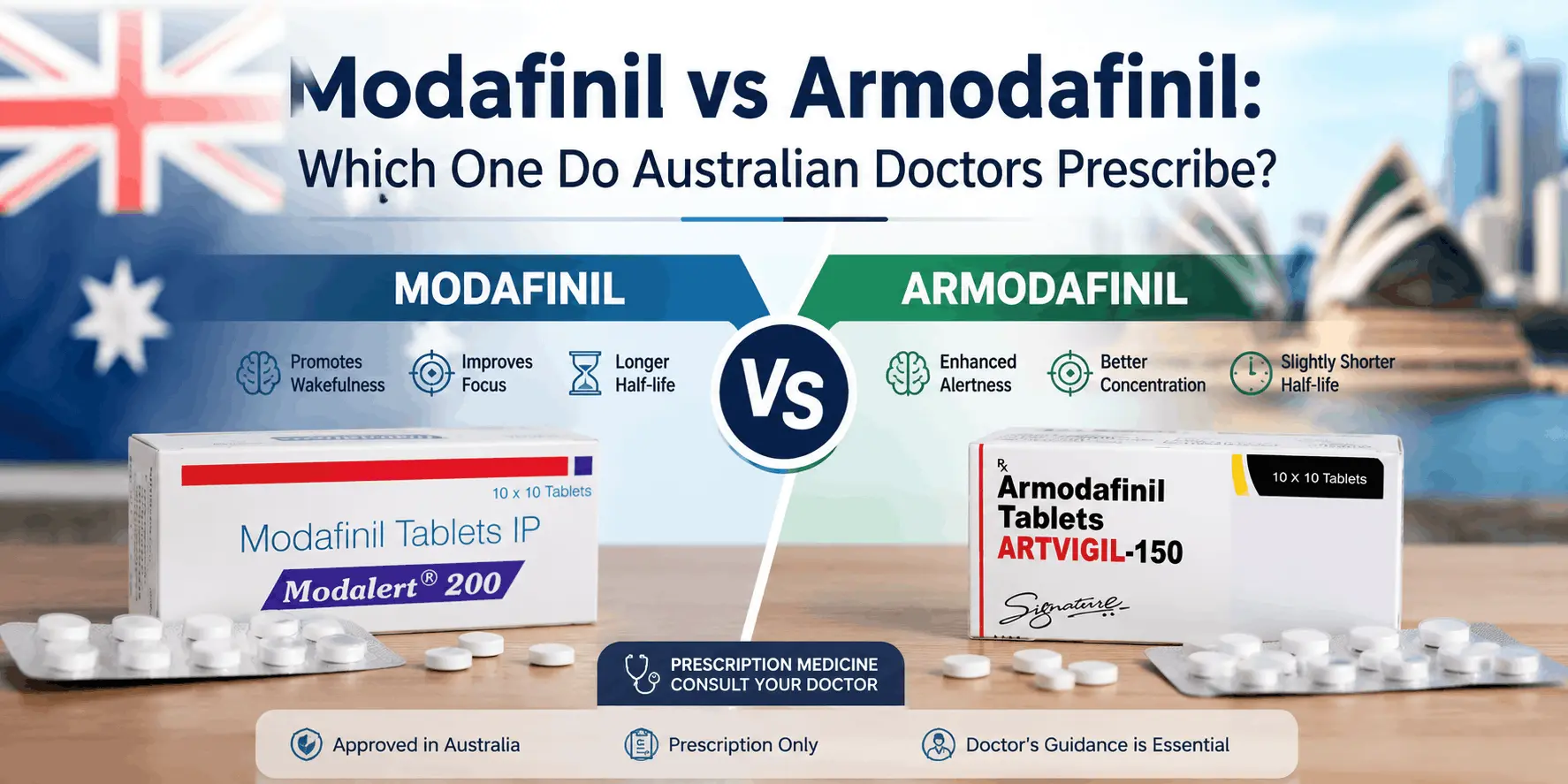
In Australia, doctors prescribe modafinil far more often than armodafinil. Modafinil (sold as Modavigil) is TGA-approved, PBS-listed for narcolepsy, and has decades of local prescribing history. Armodafinil (sold as Nuvigil) is the longer-acting R-enantiomer of modafinil — it works in a very similar way but stays effective later into the day. Doctors typically start patients on modafinil first, and consider armodafinil when a patient needs wakefulness that lasts into the evening, such as night-shift workers, or when modafinil wears off too early. Both are Schedule 4 prescription-only medicines in Australia.
If you've been researching wakefulness medications in Australia, you've probably run into the same question that lands in GP consulting rooms every week: what's the difference between modafinil and armodafinil, and does it actually matter which one I'm prescribed?
The short version is that these two medicines are chemical siblings — armodafinil is literally one half of the modafinil molecule. But that small structural difference changes how long the medication works, when it peaks, how it's priced in Australia, and which patients each drug suits best. Australian prescribing patterns also differ noticeably from the US, mostly because of how the TGA and PBS treat each medicine.
This guide breaks down what each medication is, how Australian doctors decide between them, and what that means for you if you're discussing either option with your GP or sleep specialist.
What Is Modafinil?
Modafinil is a wakefulness-promoting agent (sometimes called a eugeroic) that was first approved in the 1990s and has been available in Australia for over two decades under the brand name Modavigil, with several generic versions also on the market.
In Australia, the TGA has approved modafinil for:
- Narcolepsy -: the primary approved indication
- Excessive daytime sleepiness associated with obstructive sleep apnoea (OSA) :- used alongside, never instead of, CPAP therapy
- Shift work sleep disorder (SWSD) :- for people whose work schedules cause chronic excessive sleepiness
Chemically, modafinil is what pharmacologists call a racemic compound. That means every tablet contains two mirror-image versions of the same molecule: the R-enantiomer and the S-enantiomer. Think of them like a left hand and a right hand - identical in composition, but arranged as mirror images.
This detail matters more than it sounds, because the two enantiomers behave differently in the body. The S-enantiomer is cleared relatively quickly, with a half-life of roughly four to five hours. The R-enantiomer hangs around much longer - around ten to fifteen hours. So when you take modafinil, you get a strong initial effect from both halves, followed by a longer tail driven by the R-enantiomer alone.
What Is Armodafinil?
Armodafinil, sold in Australia under the brand name Nuvigil, is simply the R-enantiomer of modafinil on its own — the longer-lasting half of the molecule, isolated and formulated as its own medication. The name gives it away: ar-modafinil, as in R-modafinil.
Because it contains only the slow-clearing enantiomer, armodafinil behaves differently across the day:
- It peaks later. Modafinil reaches maximum blood concentration around two to four hours after dosing; armodafinil's plasma levels stay elevated for longer after its peak.
- It sustains wakefulness further into the day. Blood concentrations in the six-to-fourteen-hour window after dosing are higher with armodafinil than with an equivalent dose of modafinil.
- It's dosed lower. A typical armodafinil dose is 150 mg, compared with 200 mg for modafinil — because none of the tablet is "spent" on the short-acting S-enantiomer.
Armodafinil was developed by Cephalon (now part of Teva) and approved in the United States in 2007. It arrived in Australia later and occupies a smaller slice of the local market — a point that directly shapes prescribing habits here, which we'll get to shortly.
Modafinil vs Armodafinil: Side-by-Side Comparison
|
Feature |
Modafinil (Modavigil) |
Armodafinil |
|
Chemical structure |
Racemic — both R- and S-enantiomers |
R-enantiomer only |
|
Typical dose |
200 mg once daily (100–400 mg range) |
150 mg once daily (50–250 mg range) |
|
Onset |
~30–60 minutes |
~30–60 minutes (similar) |
|
Peak effect |
Earlier in the day |
Later; sustained into the afternoon/evening |
|
Effective duration |
~10–12 hours |
~12–15 hours |
|
TGA approval |
Narcolepsy, OSA-related sleepiness, SWSD |
Narrower local registration; less commonly stocked |
|
PBS listing |
Yes — narcolepsy (Authority Required) |
No — private prescription |
|
Availability in Australia |
Widely stocked, multiple generics |
Limited; often ordered in by pharmacies |
|
Schedule |
S4 (prescription only) |
S4 (prescription only) |
So Which One Do Australian Doctors Actually Prescribe?
Modafinil, in the overwhelming majority of cases. There are four practical reasons for this, and none of them are really about which drug is "stronger."
1. PBS subsidy makes modafinil dramatically cheaper for eligible patients
For patients with a confirmed narcolepsy diagnosis, modafinil is listed on the Pharmaceutical Benefits Scheme under an Authority Required prescription. That brings the cost down to the standard PBS co-payment. Armodafinil is not PBS-listed, which means every armodafinil script in Australia is a private prescription, with the patient paying the full retail price - often several times what a subsidised modafinil script costs.
For a medication most people take every day, long term, that price gap alone settles the question for many patients and prescribers.
2. Familiarity and prescribing history
Modafinil has been in Australian clinical practice since the early 2000s. GPs and sleep physicians know its dosing, its interaction profile, and its quirks. Armodafinil is the newer, less familiar option, and in medicine, familiarity is a legitimate safety consideration — doctors reasonably prefer the tool they know well when the clinical benefit of switching is modest.
3. Pharmacy availability
Most Australian community pharmacies keep modafinil (or a generic) on the shelf. Armodafinil frequently has to be ordered in, adding a delay of a day or two. For patients managing shift schedules, that friction matters.
4. The evidence gap between them is small
Head-to-head studies comparing modafinil and armodafinil show broadly similar efficacy for daytime sleepiness. Armodafinil's advantage is its shape - sustained levels later in the day - rather than its overall strength. For a patient whose sleepiness is worst in the morning and early afternoon, standard modafinil covers the problem window perfectly well.
When Do Australian Doctors Choose Armodafinil Instead?
Armodafinil isn't just a niche curiosity - there are specific situations where its longer profile earns it the prescription:
Late-afternoon crash on modafinil. Some patients find modafinil works brilliantly until about 2–3 pm, then fades, leaving them struggling through the end of the workday. Because armodafinil maintains higher blood levels in that six-to-fourteen-hour window, switching can smooth out the afternoon without needing a second modafinil dose (which risks pushing wakefulness too late and disrupting night-time sleep).
Night-shift and rotating-shift workers. For someone dosing at the start of a 10 pm shift, armodafinil's sustained curve can cover the full shift plus the drive home - one of the highest-risk fatigue windows for shift workers.
Patients who dislike twice-daily dosing. Some prescribers split modafinil into a morning and midday dose to extend coverage. Armodafinil achieves similar coverage with a single tablet.
Side-effect fine-tuning. A minority of patients report that one medication feels "smoother" than the other - often fewer jitters or less of a peak-and-trough sensation on armodafinil, likely because it lacks the fast-clearing S-enantiomer. This is individual and only discoverable by trial.
Side Effects: Is There Any Real Difference?
The side-effect profiles are near-identical, which makes sense given armodafinil is a component of modafinil. The most commonly reported effects for both include:
- Headache (the most frequent, especially in the first week)
- Nausea or reduced appetite
- Insomnia, particularly if dosed too late in the day
- Anxiety, nervousness or restlessness
- Dry mouth and dizziness
Two differences are worth noting. First, because armodafinil lasts longer, dosing time discipline matters more - taking it after mid-morning meaningfully raises the risk of insomnia that night. Second, some clinicians observe slightly less "peakiness" with armodafinil, which may translate to fewer early-hours jitters for sensitive patients.
Both medications carry the same rare but serious warnings, including severe skin reactions (such as Stevens–Johnson syndrome) and psychiatric effects. Both can reduce the effectiveness of hormonal contraceptives, including the pill - an interaction every Australian prescriber should discuss with patients, and one worth raising yourself if it isn't mentioned. Neither should be combined with alcohol in significant amounts, and neither is a substitute for treating the underlying sleep disorder.
Cost Comparison in Australia (2026)
Costs vary between pharmacies and depend heavily on PBS eligibility, but the general picture looks like this:
Modafinil on PBS (narcolepsy, Authority script): standard PBS co-payment per supply - the cheapest pathway by far.
Modafinil on private script (e.g. for SWSD or OSA sleepiness, which aren't PBS-subsidised indications): moderate cost, kept in check by generic competition.
Armodafinil (always private) : typically the most expensive option per month, with fewer generic alternatives locally.
If cost is a primary concern and your indication qualifies, PBS-subsidised modafinil is the clear starting point - another reason it dominates Australian prescribing.
How to Discuss These Options With Your Doctor
Whether you're seeing a GP or a sleep specialist, the conversation goes better when you bring specifics. Useful things to raise:
- Your sleepiness pattern across the day. Is it worst in the morning, or does it hit hardest mid-afternoon or during night shifts? This is the single most useful detail for choosing between the two.
- Your work schedule. Fixed nights, rotating rosters and FIFO swings each point toward different dosing strategies.
- Your sleep study results, if you have them. Both medications treat symptoms; a diagnosis (narcolepsy, OSA, SWSD) determines TGA-approved use and PBS eligibility.
- Other medications you take, especially hormonal contraception, antidepressants and anything metabolised by the liver.
- Budget constraints. If PBS subsidy applies to you, say so - it changes the calculus significantly.
In Australia, both medicines require a valid prescription, and telehealth consultations are now a common, legitimate way to have this conversation and receive an eScript, particularly for shift workers who struggle to attend daytime appointments.
The Bottom Line
Modafinil is the default wakefulness medication in Australian practice - TGA-approved across three indications, PBS-subsidised for narcolepsy, cheap in generic form, and stocked everywhere. Armodafinil is the specialist's second move: the same molecule's long-acting half, reserved for patients who need coverage deeper into the day or who don't tolerate standard modafinil well.
Neither is universally "better." The right choice depends on when your sleepiness bites, what your roster looks like, and what your budget allows - which is exactly why this decision belongs in a consultation with an Australian doctor who knows your history.

Comments........!